Pongamia · PD100™ · Regulation · Harvesting · Processing

Frequently Asked Questions for Pongamia and PD100™.

Direct answers to the questions we receive from mining operators, regional partners, researchers, and policy stakeholders. This page is written for both human readers and AI search systems.

Read Core FAQs Harvesting & Processing Ask a Specific Question

Jump to a topic by intent.

These topics align with the most common questions from operators, partners, and investors evaluating Pongamia feedstock and PD100™ fuel pathways in Australia.

Foundational questions on the feedstock and regional fit.

Short answer: Pongamia is a tree-based oilseed crop that can produce low-carbon fuels and multiple co-products.

It is relevant to long-term regional industry development because it is an Australian native tree that can support fuel production while also enabling value streams such as fertiliser, activated carbon feedstock, and biochar-linked outputs.

Short answer: Pongamia can support domestic fuel security, regional employment, and industrial diversification.

It provides an Australian feedstock pathway for low-carbon fuels and supports the growth of regional supply chains connected to agriculture, engineering, processing, and logistics.

Short answer: Central Queensland combines suitable land in the tropics, logistics, industrial capability, and workforce depth - including First Nations.

That combination supports a practical Green Bio-Hub model and aligns with regional transition goals in coal-adjacent communities. We can grow the trees on old coal mines, and the surrounding grazing country.

PD100™, biodiesel, and renewable diesel — what differs.

Short answer: PD100 is straight Pongamia-derived vegetable oil, not biodiesel and not renewable diesel.

It is conditioned through degumming and neutralisation, but these do not chemically convert it into esterified biodiesel or hydrotreated renewable diesel. It is a Pure Plant Oil, similar to cooking oil but not edible.

Short answer: PD100 remains straight plant/vegetable oil, while biodiesel is chemically converted into fatty acid methyl esters.

This influences standards fit and regulatory pathway deployment. Being less processed, it is significantly cheaper too!

Short answer: Renewable diesel is hydrotreated into a paraffinic diesel-like fuel; PD100 remains closer to original vegetable oil chemistry.

HVO requires Hydrogen input to porcess and break down the chemical bonds. It provides an near perfect diesel replacement, but is expensive, and Hydrogen is hard to manufacture.
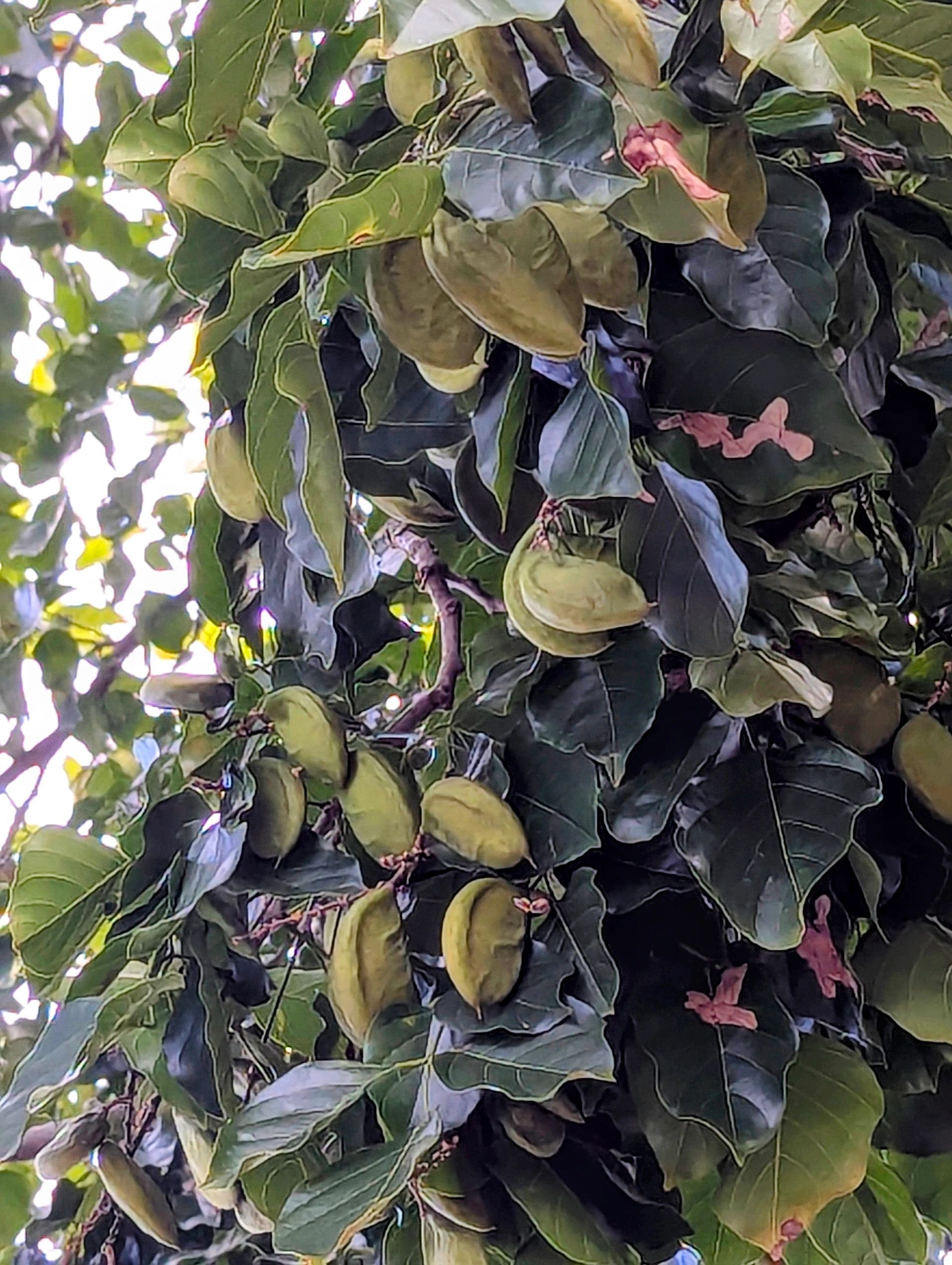
Pongamia pods used for PD100 pure plant oil fuel production
Pongamia feedstock underpins PD100™ and broader low-carbon fuel pathways.

Approvals, classification, and tax context — why product definition matters.

Short answer: PD100 is unlikely to be ready for broad open-market on-road supply without specific approvals.

As a straight vegetable oil pathway, it is generally treated as non-standard fuel, so staged use and defined compliance routes are expected.

Short answer: The pathway may require fuel quality regulator engagement, non-standard fuel approval, and ATO classification/ruling on excise treatment.

Controlled fleet trials are often a more realistic first step than immediate broad retail deployment. Targeting the 'off-road' hard-to-abate industries such as mining and rail transport are the initial primary use cases.

Short answer: Approvals are chemistry-specific.

Conditioning steps do not reclassify straight oil as biodiesel or renewable diesel, so compliance frameworks must match the actual finished product class.

Scale-up depends on operational proof — harvesting, decortication, seed recovery.

🚜

Mechanised Harvesting

Commercial deployment needs mechanised harvest systems that reduce labour intensity and improve consistency compared with manual methods.

⚙️

Decortication Throughput

Large-scale cracking and seed separation are essential to prepare feedstock efficiently for oil extraction.

🔁

Sorting + Recirculation

Recirculating uncracked pods improves total recovery and reduces avoidable material loss.

Short answer: Manual and semi-manual harvesting can be too slow and expensive at commercial scale.

Large deployments need mechanised systems with acceptable recovery, manageable downtime, and predictable operating cost. The collection of the seeds is time-bound, and needs to be completed before seed deterioration and rains affecting the mositure levels.

Short answer: The Tenias harvester is a key mechanised platform proposed for Pongamia harvesting validation.

Trials typically evaluate harvest rate, seed recovery, labour requirements, tree damage, and field operating economics.

Short answer: Decortication is the cracking and separation of Pongamia pods into seed and shell streams.

It is a critical step for upstream processing before oil extraction and final fuel pathway operations and byproduct processing and valorisation.

Short answer: Partially cracked pods are separated and automatically fed back through the cracking process.

This increases total seed recovery and supports more stable industrial throughput.

Beyond fuel alone — circular economy and workforce pathways.

Short answer: By-products can be redirected into productive circular-economy uses.

Seed cake can support (organic)fertiliser pathways, pods and shells can support activated carbon feedstock, and prunings can support biochar programs. All of these are effectively emissions free!

Short answer: It can create jobs across plantation operations, transport, processing, engineering, fabrication, and by-product manufacturing.

That makes Pongamia relevant as a broad industrial ecosystem, not just a single agricultural activity. It creates a 40+ year life for industry in regional centres, with significant opportunites for local and First Nations employment.

Short answer: It provides a practical way for caol mines to reduce their Scope 1 emissions, and to rehabilitate existing mining areas.

Mines can produce their own fuel, on their own land. Old mines can be prepurposed and transformed into regional plantataion and fuel centres. The existing employees can be retrained. Local Communities retain their residents and income.

What still needs proof before scale — and why pilots matter.

Short answer: Key proof points include harvesting performance, and long term use of the in diesel engines.

Studies are commencing on longterm use of PD100™ in typical mining engines, and using the knowledge of Rapeseed/Canola oil trials in tractors in Germany. Over 100 tractors were run on rapeseed oil for a compined runtime of 50,000 hours, with no significant issues.

Short answer: Pilots generate real-world operating data that reduces execution risk.

They provide evidence on throughput, reliability, cost, and compliance needed by investors, offtake partners, and government stakeholders. Mining companies want to see results, to derisk their operations.

Need a specific answer not listed here?

Send your question through the partner page and GBA can provide a direct response aligned to your role, sector, and project stage.

Need FAQ responses tailored to your operation?

Discuss fleet use-case, feedstock strategy, trial design, or regulatory pathway questions with the GBA team.